
Murals

From his birth at Shivneri to his coronation and his visit to Srisailam — the life of Shivaji Maharaj as told in the murals of the Darbar Hall.

Index of murals

Mural 1

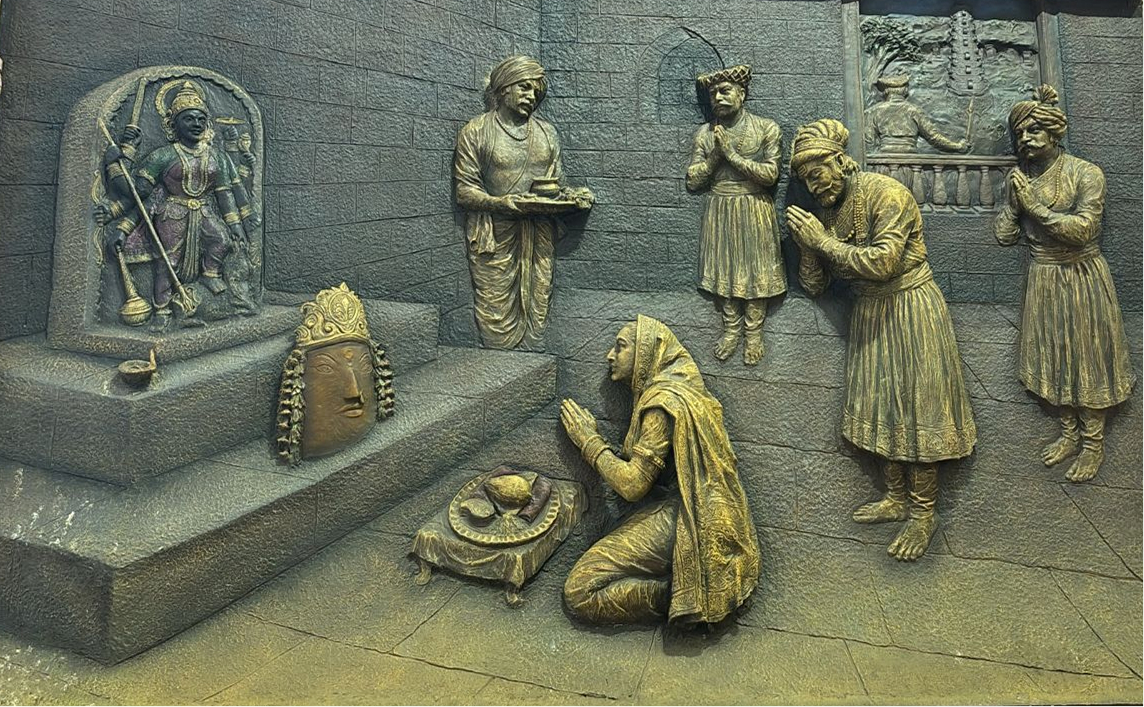
Shahaji Raje and Jijamata Seek the Blessings of Goddess Shivai at Shivneri Fort

Shahaji Raje and Jijamata visited Goddess Shivai Devi at Shivneri Fort. Jijamata was expecting a child at the time, and experienced physicians were appointed at the fort to take care of her.

Back to top ↑
Mural 2

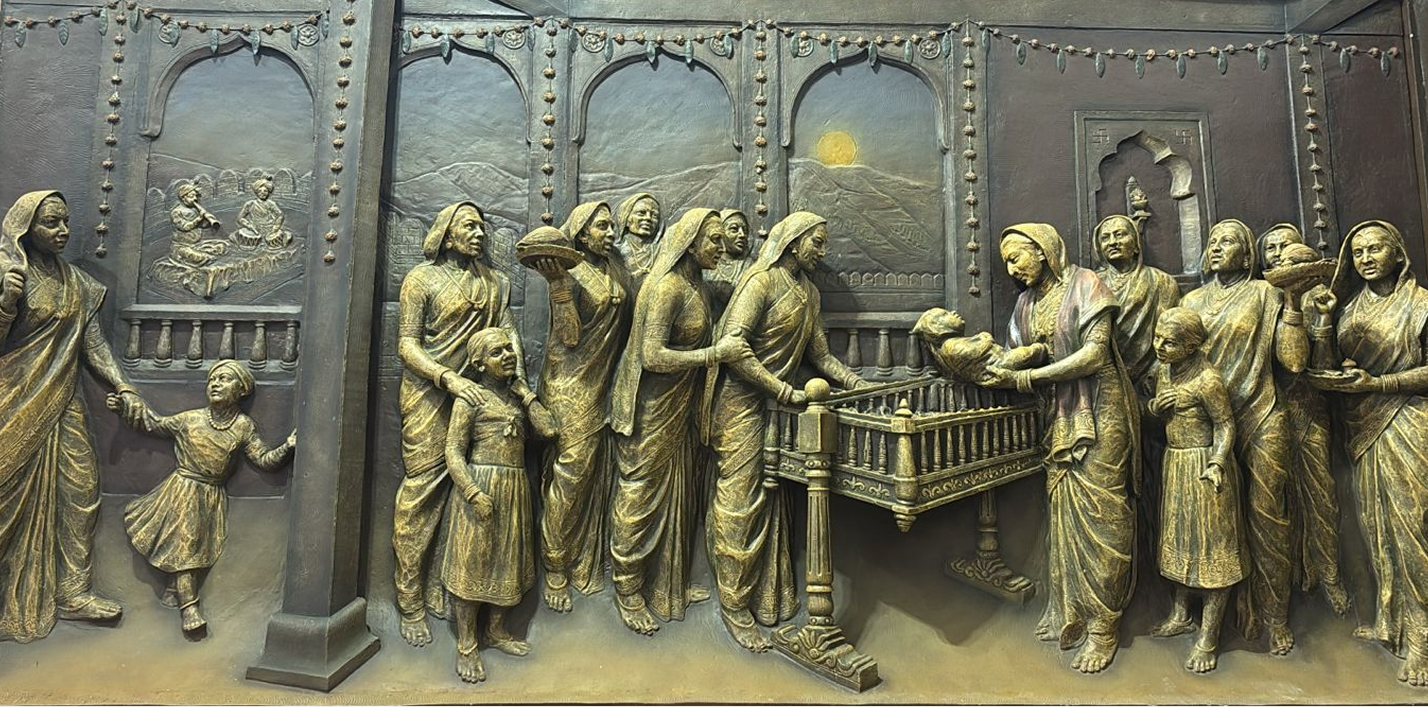
Birth of Shivaji

On 19 February 1630, under a very auspicious constellation, Jijabai, the wife of Shahaji Raje, gave birth to a son at Shivneri Fort. Since the child was born at Shivneri, he was named Shivaji. Shahaji Raje later came to see the newborn along with his elder son, Sambhaji. Overjoyed by the birth of his son, he gave generously in charity in celebration.

Back to top ↑
Mural 3

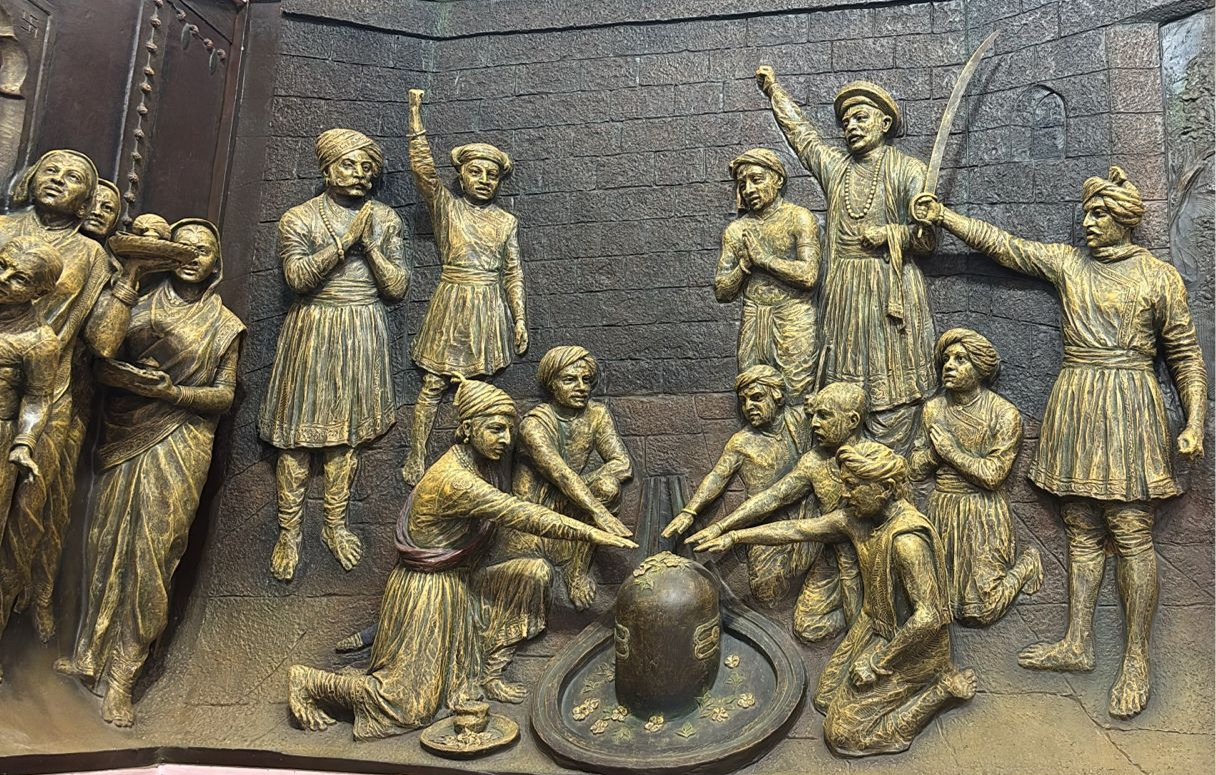
Shivaji and His Companions Take the Oath at Rohideshwar

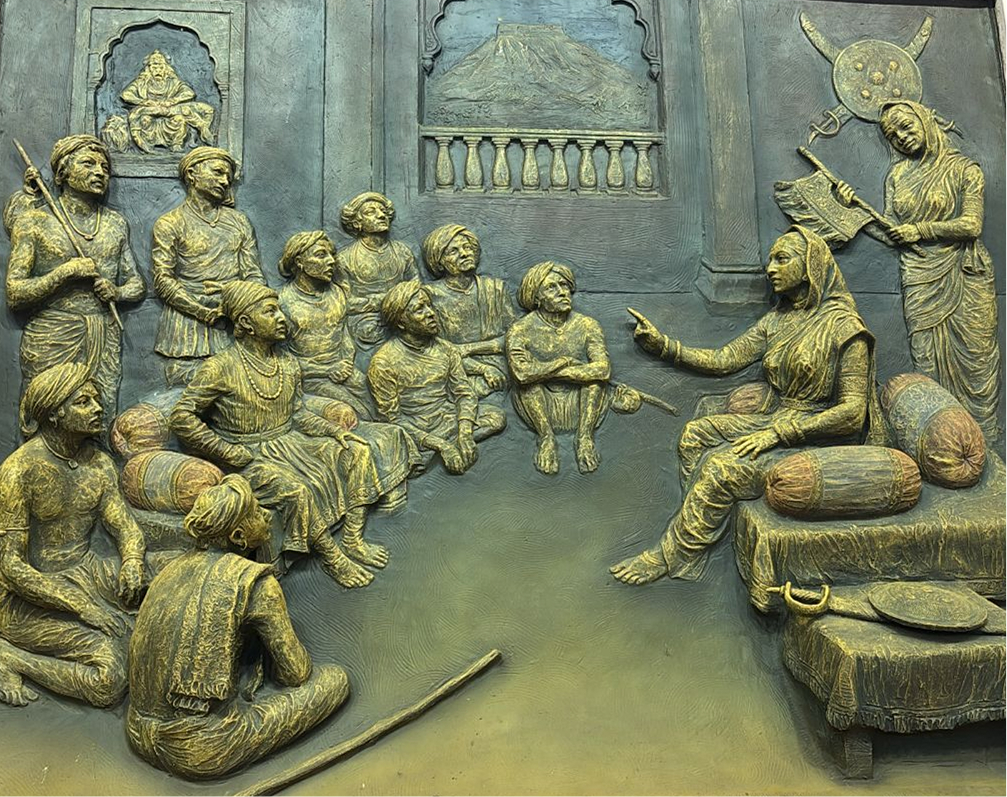
The people of the Pune province were being inspired by the idea of Swaraj and were raising their voices against the atrocities of the Sultanate. On 23 May 1642, the young Shivaji, then twelve years old, and his companions collectively took the oath of Swaraj in the holy Shiva temple at Rohideshwar.

Back to top ↑
Mural 4

Education of Shivaji

Young Shivaji became well versed in the Shruti, Smriti and Puranas, governance, the Ramayana and the Mahabharata, poetry, physical exercise, architecture, archery, several languages, verses and aphorisms, and riding elephants, horses and chariots. He was trained in the use of the sword, bow, chakra and spear, and in various forms of warfare. He also learned fort construction, military strategy, escape techniques, detection of poisoning, the examination of gemstones and other arts and sciences.

Back to top ↑
Mural 5

Capture of Torna and Rajgad

The fort of Torna lay uninhabited in the Kanad Valley, to the south-west of Pune. No Adil Shahi noble was stationed there, and young Shivaji Raje captured the fort during 1645–46. A mountain called Murumbadev lay to the south-east of Torna, and it too was unattended. Shivaji took control of this mountain and immediately began building a fort on it, which he named Rajgad. Rajgad later became the first capital of the Maratha kingdom.

Back to top ↑
Mural 6

Beginning of the Maratha Navy

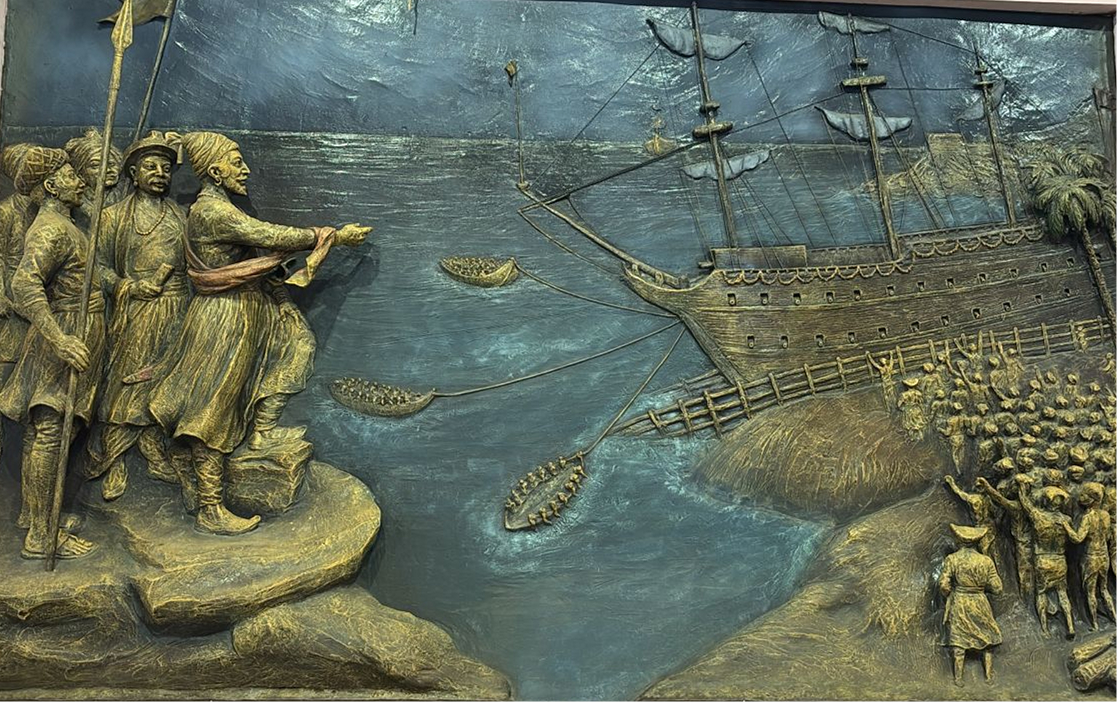
Shivaji Maharaj conquered Kalyan and Bhiwandi on 24 October 1657, and Pen later came under his control. At these places he began to build ships. With the help of Portuguese artisans, Shivaji Maharaj built warships and established Maratha strength at sea. The Maratha fleet consisted of warships such as the Gallivat, Gurab, Machwa, Tarande, Pal, Tirkati, Mahagiri, Taru and Fatemar, as well as merchant vessels such as the Machwa, Batela, Taru, Shibad, Mahagiri, Balav and Manji.

Back to top ↑
Mural 7

Afzal Khan Takes Up the Challenge

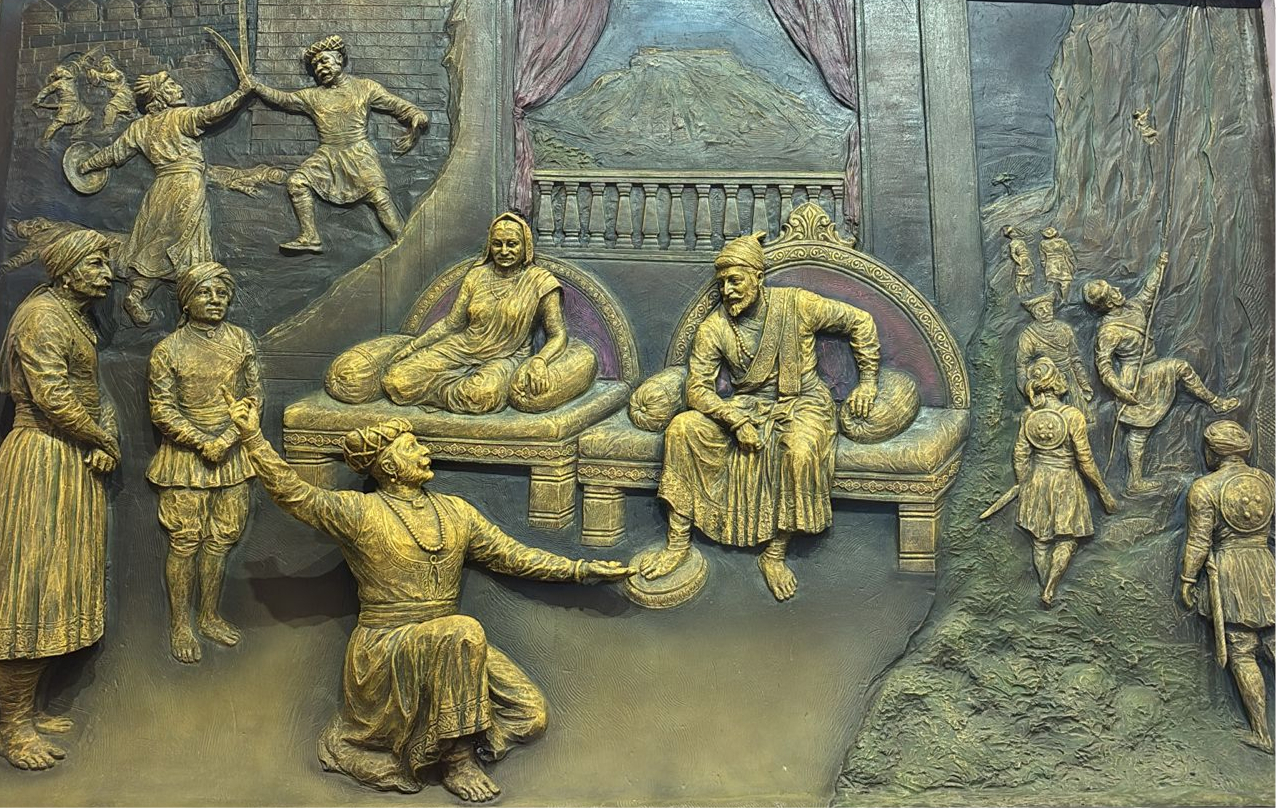
To curb Shivaji Maharaj's growing power, Ali Adil Shah and Badi Saheba decided to send a royal general against the Maratha king. However, no chief in the Adil Shahi court was willing to accept this responsibility. At that moment Afzal Khan stepped forward, picked up the tambul (betel leaf) and declared, “Who is Shivaji? I will bring him back alive as a prisoner, without even alighting from my horse.”

Back to top ↑
Mural 8

The Meeting at Pratapgad

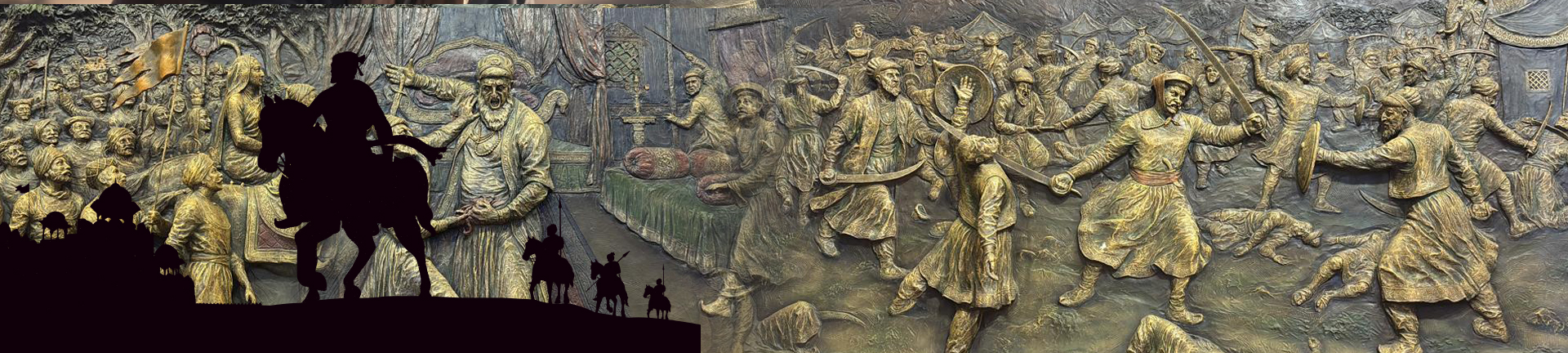
On Thursday, 10 November 1659, Shivaji Maharaj and Afzal Khan met at Pratapgad. During the meeting, Afzal Khan asked Shivaji Maharaj to surrender completely and opened his arms to embrace him. As soon as they embraced, Afzal Khan gripped Shivaji Maharaj's head under his left arm and struck at his side with a hidden dagger. Because Shivaji Maharaj was wearing armour beneath his robe, the blade only grazed the armour and tore his garment.

In the blink of an eye, Shivaji Maharaj struck back with the wagh-nakh (tiger claws) on his left hand and the dagger in his right, and Afzal Khan fell in the encounter.

Back to top ↑
Mural 9

Bajiprabhu Deshpande's Stand at Ghodkhind

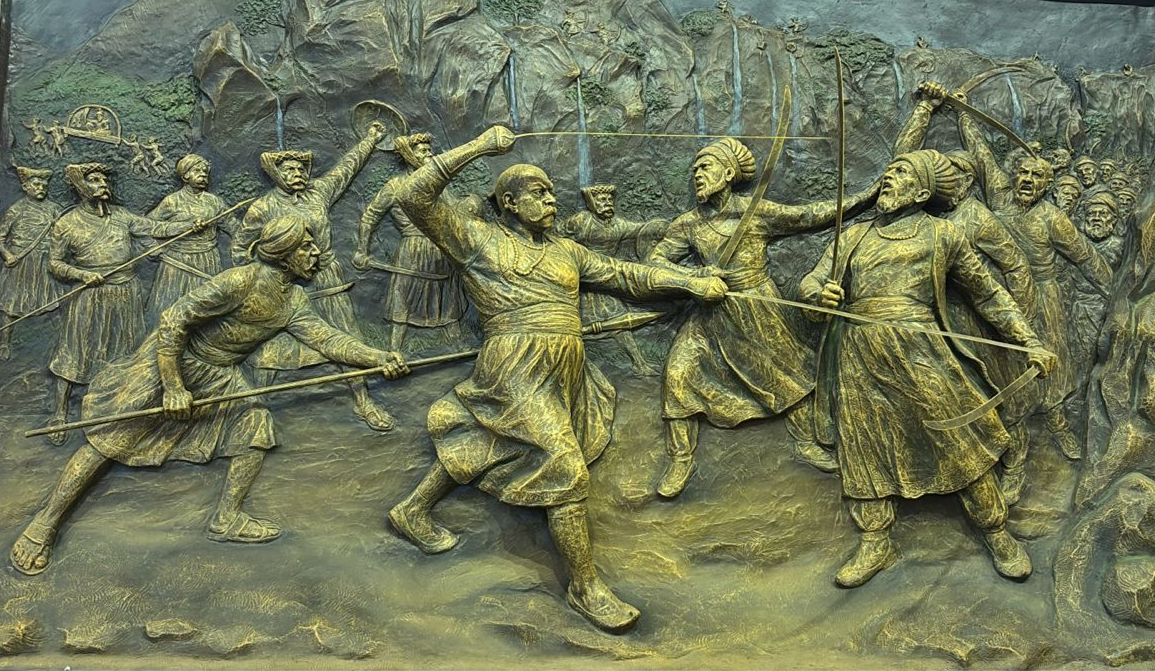
On 13 July 1660, Siddi Jauhar's army besieged Panhala Fort. Shivaji Maharaj's network of spies worked tirelessly to find a way out, and Shivaji Maharaj escaped in a palanquin towards Ghodkhind, with the enemy army in pursuit. Seeing the approaching army, Bajiprabhu Deshpande resolved to hold the pass at Ghodkhind. He fought with great courage and gave his life, holding the enemy back until Shivaji Maharaj had safely reached Vishalgad Fort.

Back to top ↑
Mural 10

The Surprise Raid on Shaista Khan

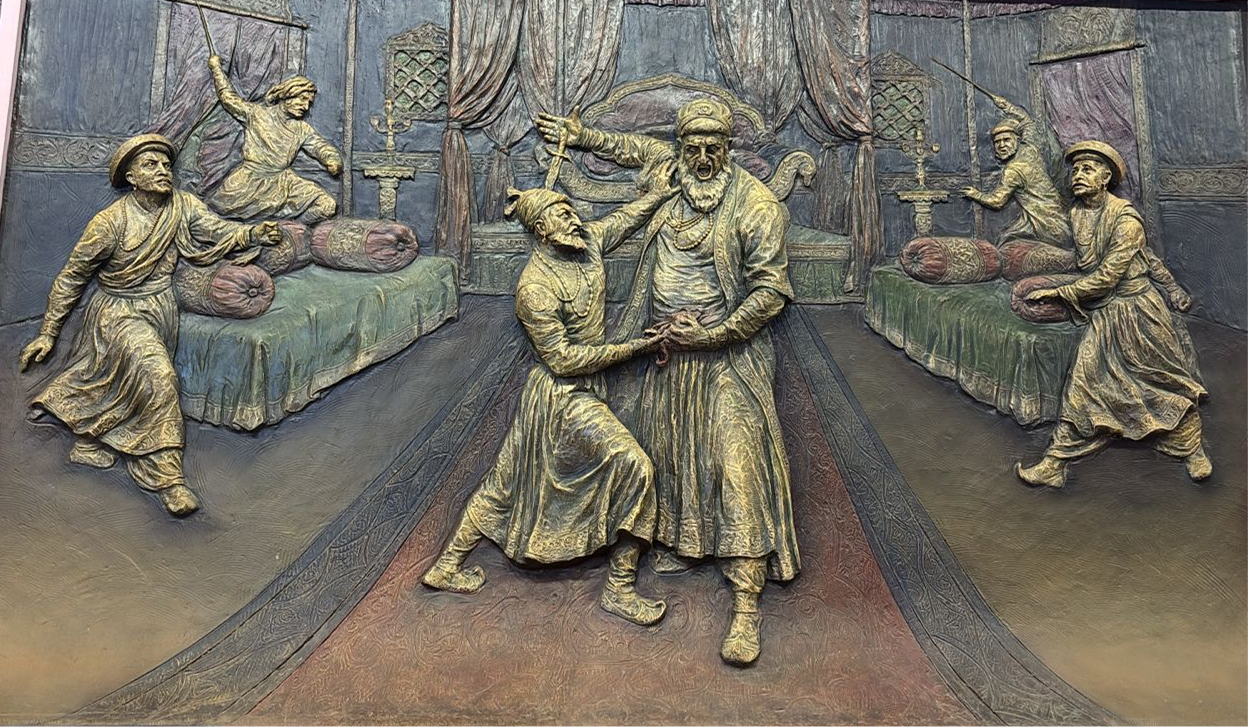
After Aurangzeb seized the Mughal throne at Delhi, he appointed his uncle Shaista Khan as Subhedar of the Deccan in 1660 and gave him an army of 80,000. Staying at Shivaji Maharaj's own Lal Mahal in Pune, the new Subhedar began laying waste to the Maratha kingdom. On the night of 5 April 1663, Shivaji Maharaj made a daring raid on Shaista Khan's residence. Having spent his childhood in this mansion, he knew every part of it. Shaista Khan survived the attack but lost three fingers of his right hand. Shaken, he left Pune with his entire army within three days, and the threat to the kingdom passed.

Back to top ↑
Mural 11

Sacrifice of Murarbaji Deshpande

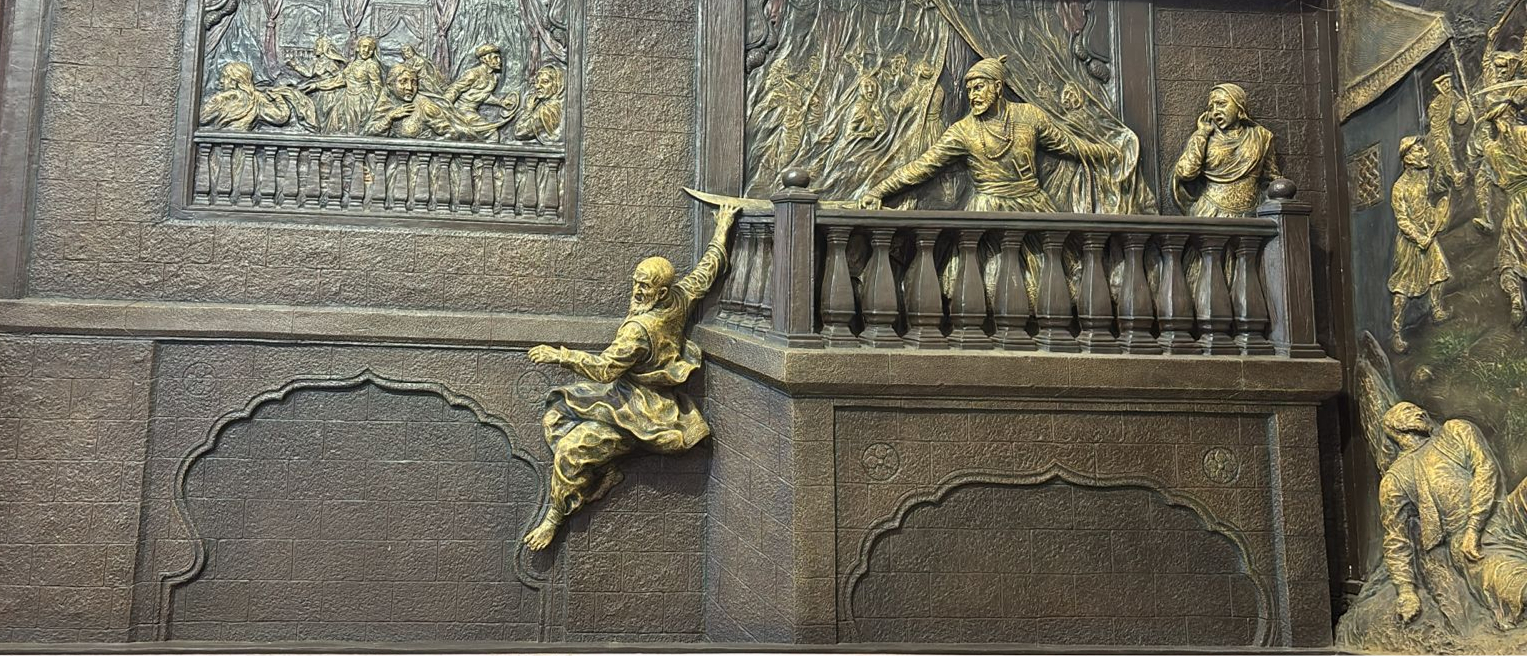
To retaliate against Shivaji Maharaj's successive victories, Aurangzeb sent two of his prominent mansabdars, Mirza Raja Jai Singh and Dilir Khan, to the Deccan. They besieged the fort of Purandar, where Murarbaji Deshpande was leading the Marathas. After Dilir Khan launched a major attack on Purandar in June 1665, a fierce battle followed. Impressed by Murarbaji's valour, Dilir Khan tried to lure him into joining the Mughal army. Murarbaji rejected the offer and charged at Dilir Khan directly, but was struck in the neck by an arrow. Murarbaji Deshpande gave his life for the Maratha kingdom.

Back to top ↑
Mural 12

Shivaji Maharaj's Visit to Agra

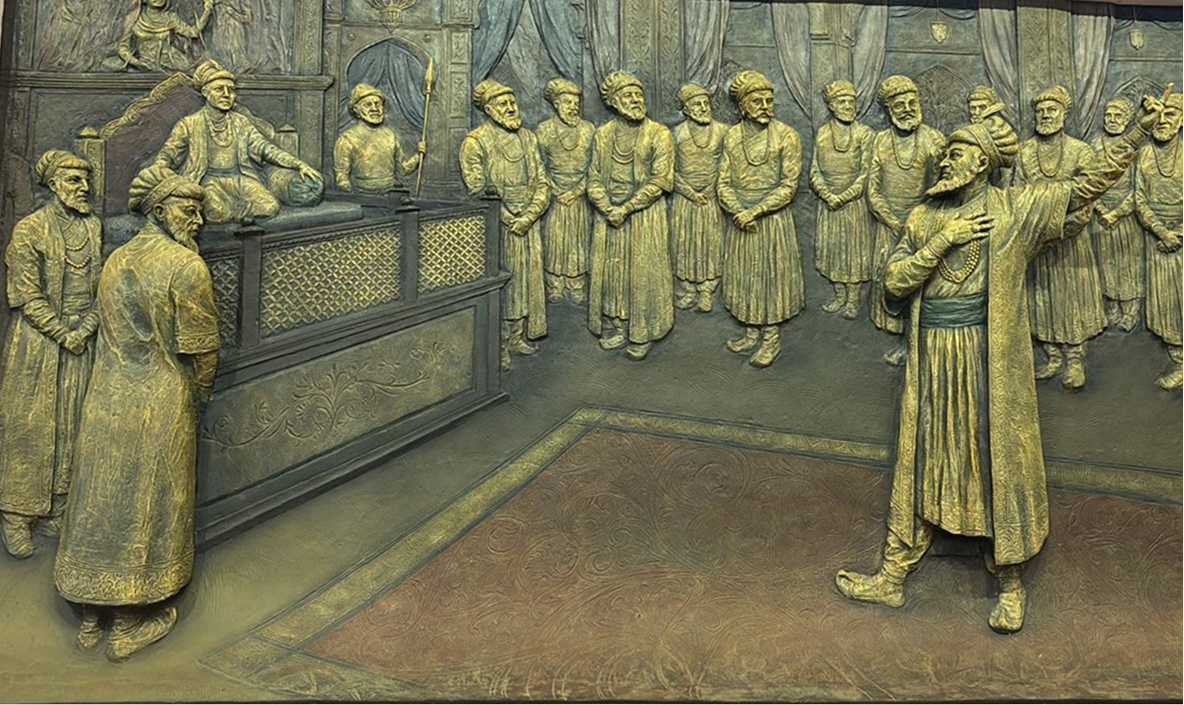
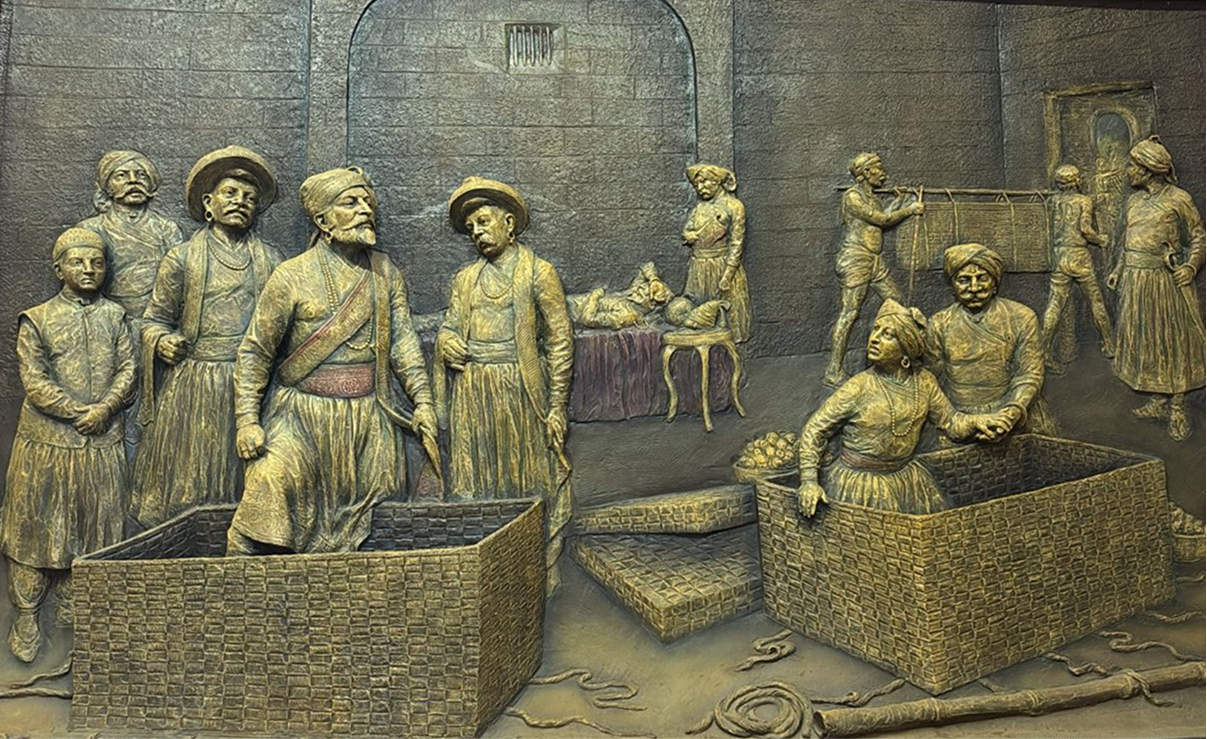
Shivaji Maharaj went to Agra to meet Aurangzeb, and met him on 12 May 1666 in the Diwan-i-Khas of the Red Fort at Agra. Insulted during the audience, Shivaji Maharaj turned his back on the Peacock Throne and left the court. Aurangzeb placed him under arrest. Together with his son Sambhaji, Shivaji Maharaj escaped from Aurangzeb's custody on 17 August 1666 and, after a long journey of three months, reached Rajgad safely on 20 November 1666.

Back to top ↑
Mural 13

Tanaji Malusare

To check Shivaji Maharaj's activities, Aurangzeb sent Mirza Raja Jai Singh against the Maratha kingdom with a huge army. Shivaji Maharaj had to make a treaty with Jai Singh, surrendering twenty-three forts and territory yielding a revenue of four lakh hons to the Mughals. The campaign to recapture these forts was begun by Subhedar Tanaji Malusare. He gave his life in a fierce battle with Udaybhan Rathod on 4 February 1670 and won Sinhagad. Shivaji Maharaj was deeply grieved by Tanaji's death and said, ‘The fort is won, but the lion is lost.’

Back to top ↑
Mural 14

Meeting of Shivaji Maharaj and Samarth Ramdas Swami

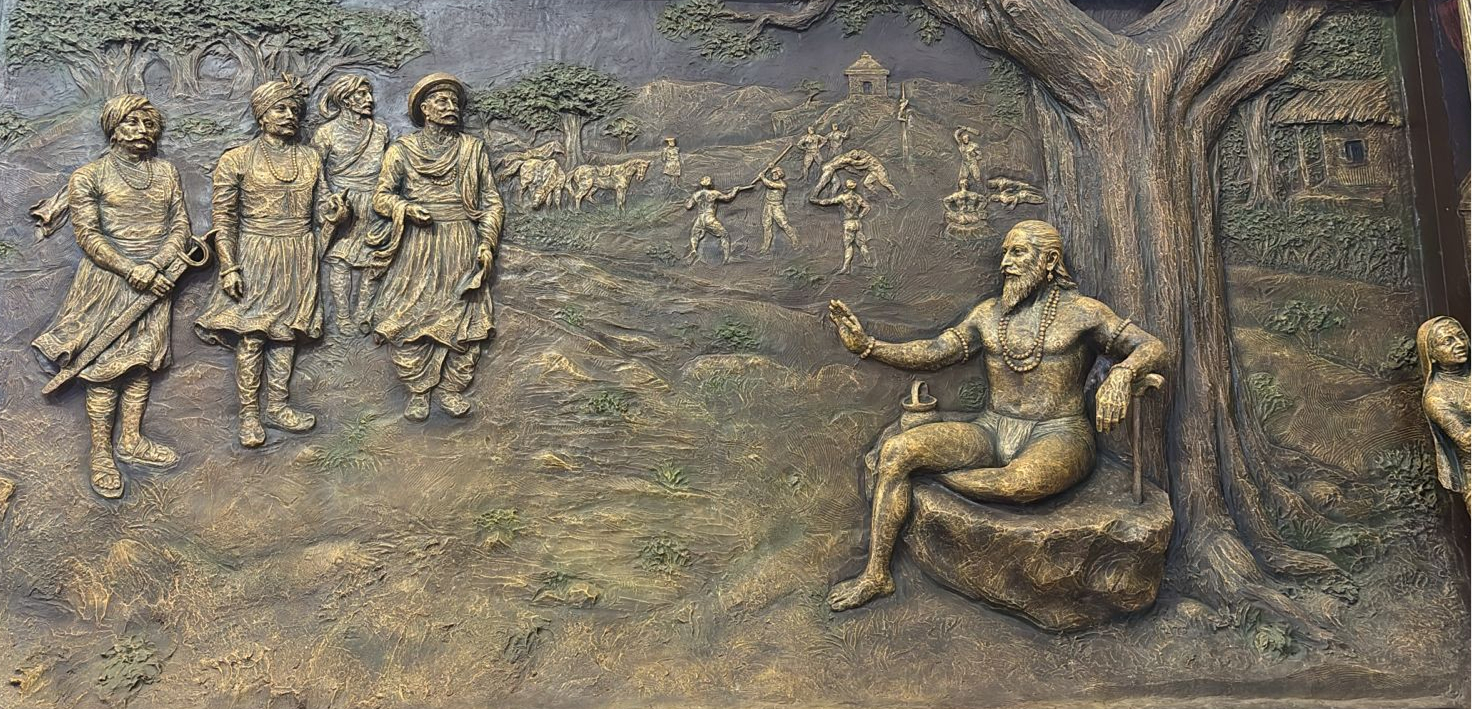
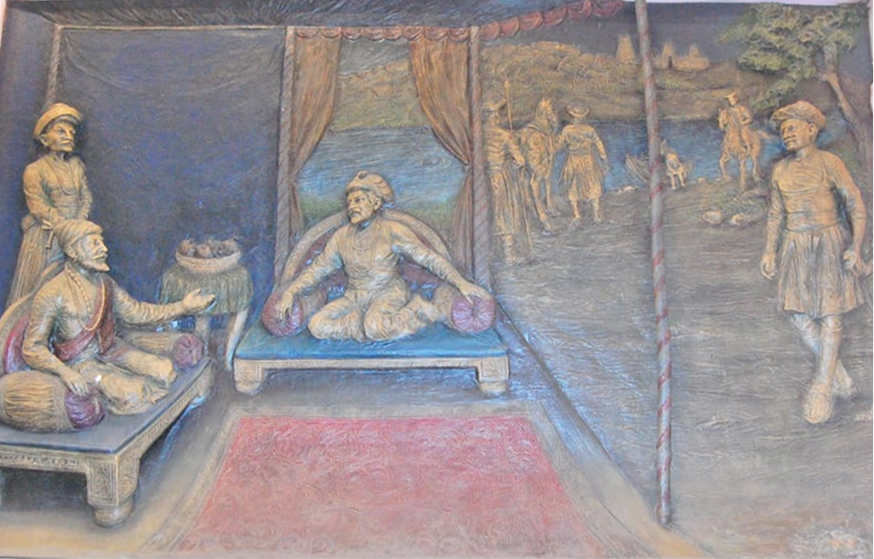
In the month of Shravan in 1672 CE, Shivaji Maharaj and Samarth Ramdas Swami met near Chaphal, and a strong bond formed between them. Shivaji Maharaj gave the fort of Parli, also known as Sajjangad, to Ramdas Swami as his residence.

Back to top ↑
Mural 15

The Coronation of Shivaji Maharaj

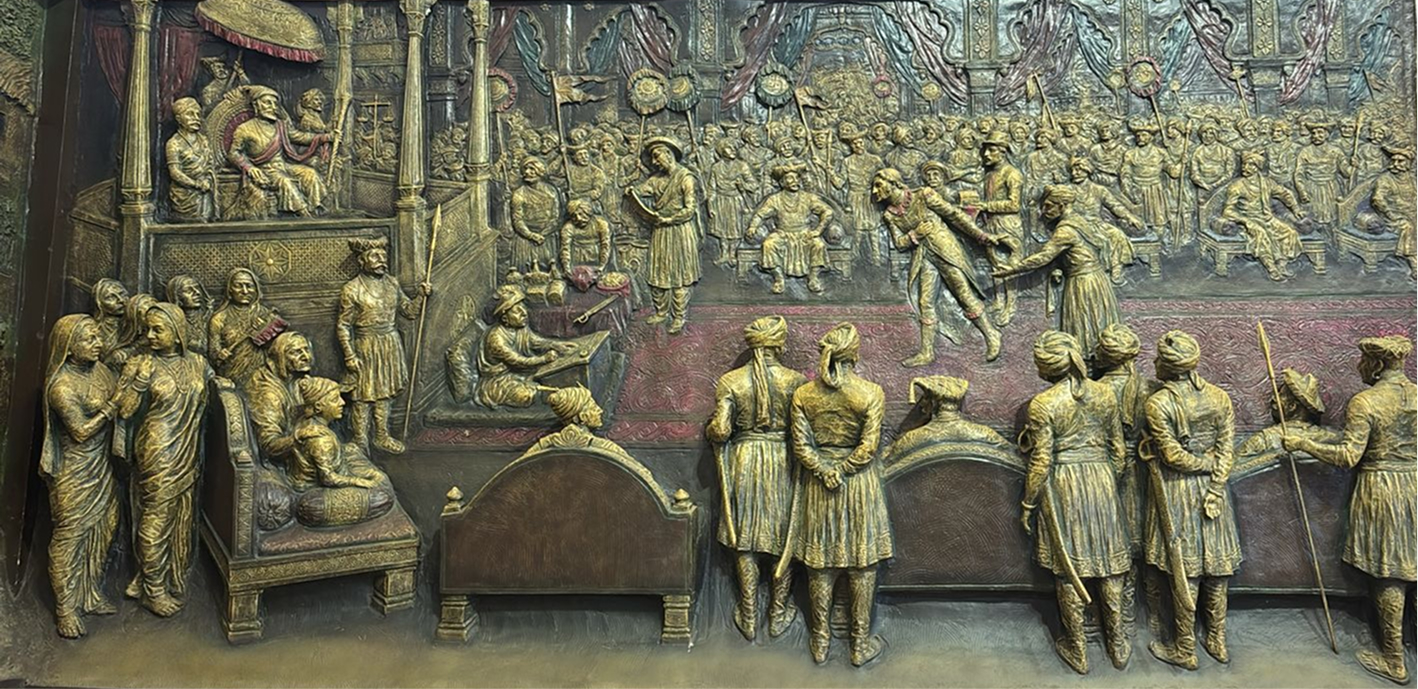
On Jyeshtha Shuddha Trayodashi, Saturday, Shaka 1596, Ananda Samvatsara — 6 June 1674 — Shivaji Maharaj was crowned at Raigad. As he ascended the throne, the assembly rang with the acclamation ‘Praudh Pratap Purandar, Kshatriya Kulavatans, Sinhasanadhishwar, Maharajadhiraj, Shri Shiv Chhatrapati ki Jai!’ The English envoys Henry Oxenden, George Robinson and Thomas Mitchell attended the coronation and presented valuable gifts. With the coronation, Indian sovereignty was re-established.

Back to top ↑
Mural 16

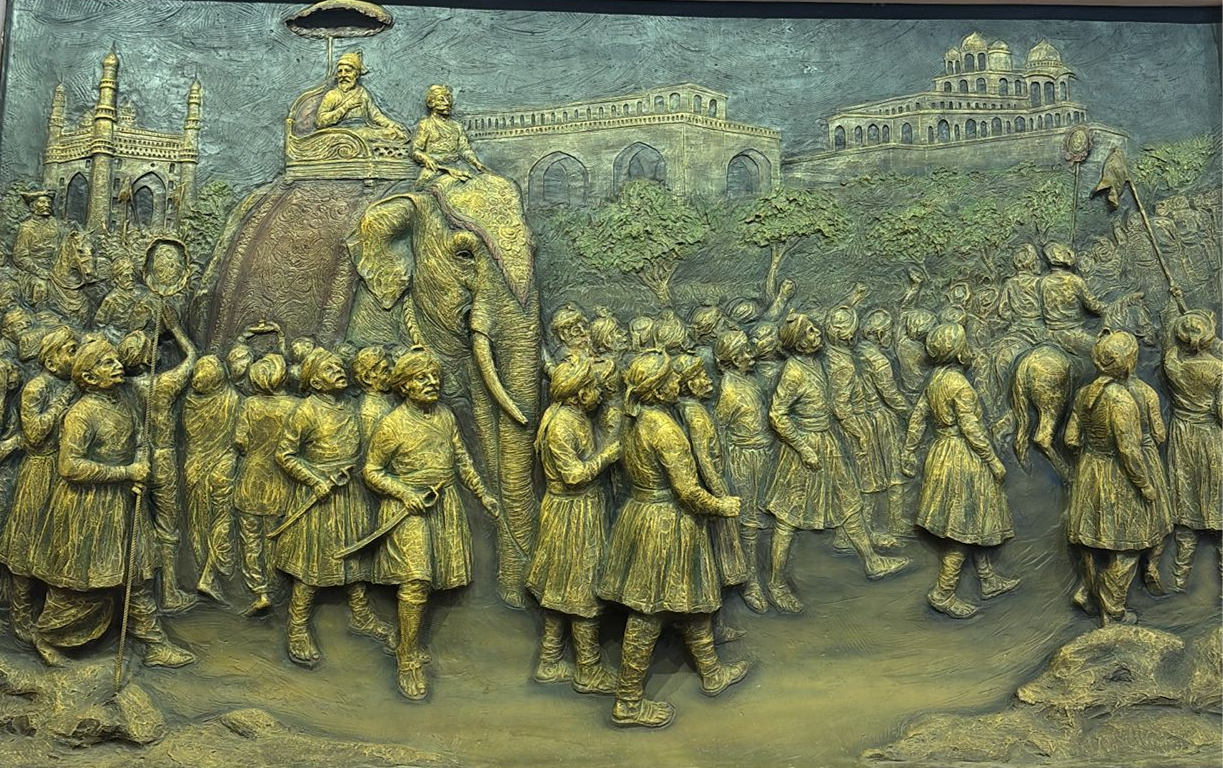
Shivaji Maharaj's Visit to Abul Hasan Qutb Shah at Bhaganagar

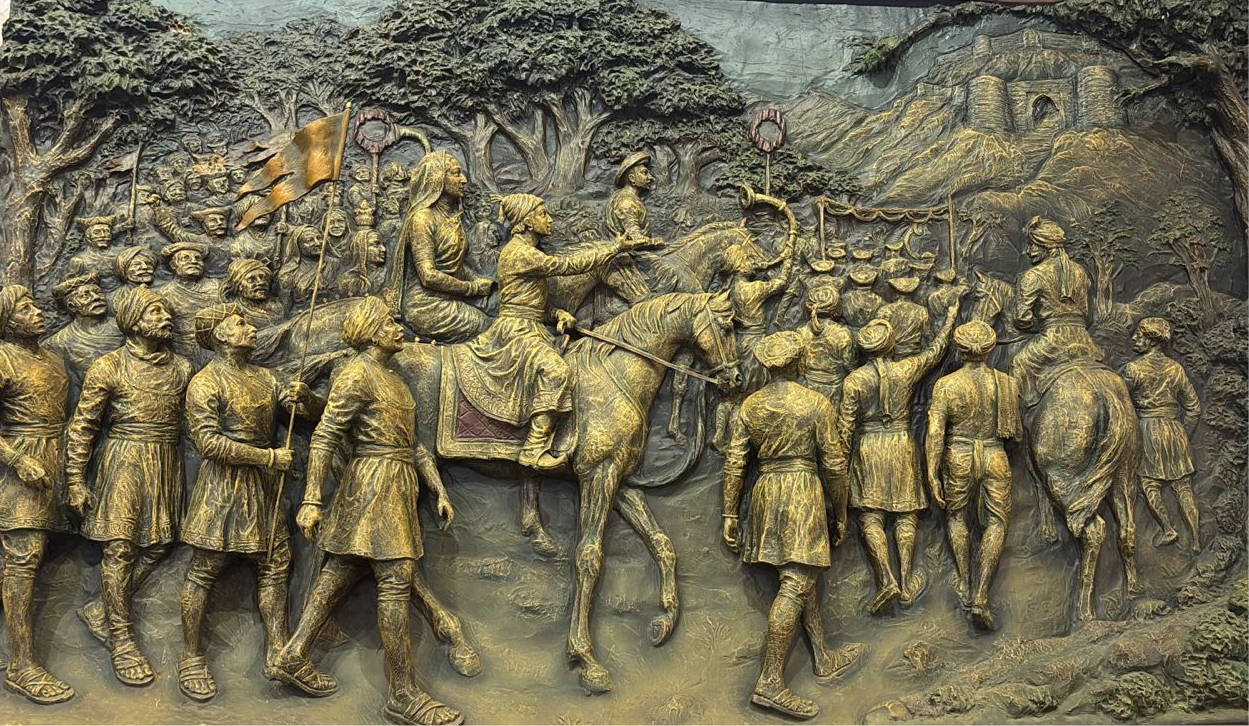
Shivaji Maharaj visited Abul Hasan Tana Shah Qutb Shah of Golconda, entering Bhaganagar on 5 February 1677. The whole city was decorated: kumkum and saffron rangolis were drawn, festoons and pennants were hung everywhere, and gudhis and torans were raised. All of Bhaganagar was eager to see Shivaji Maharaj, and as he entered the city, gold and silver flowers were showered upon him.

Back to top ↑
Mural 17

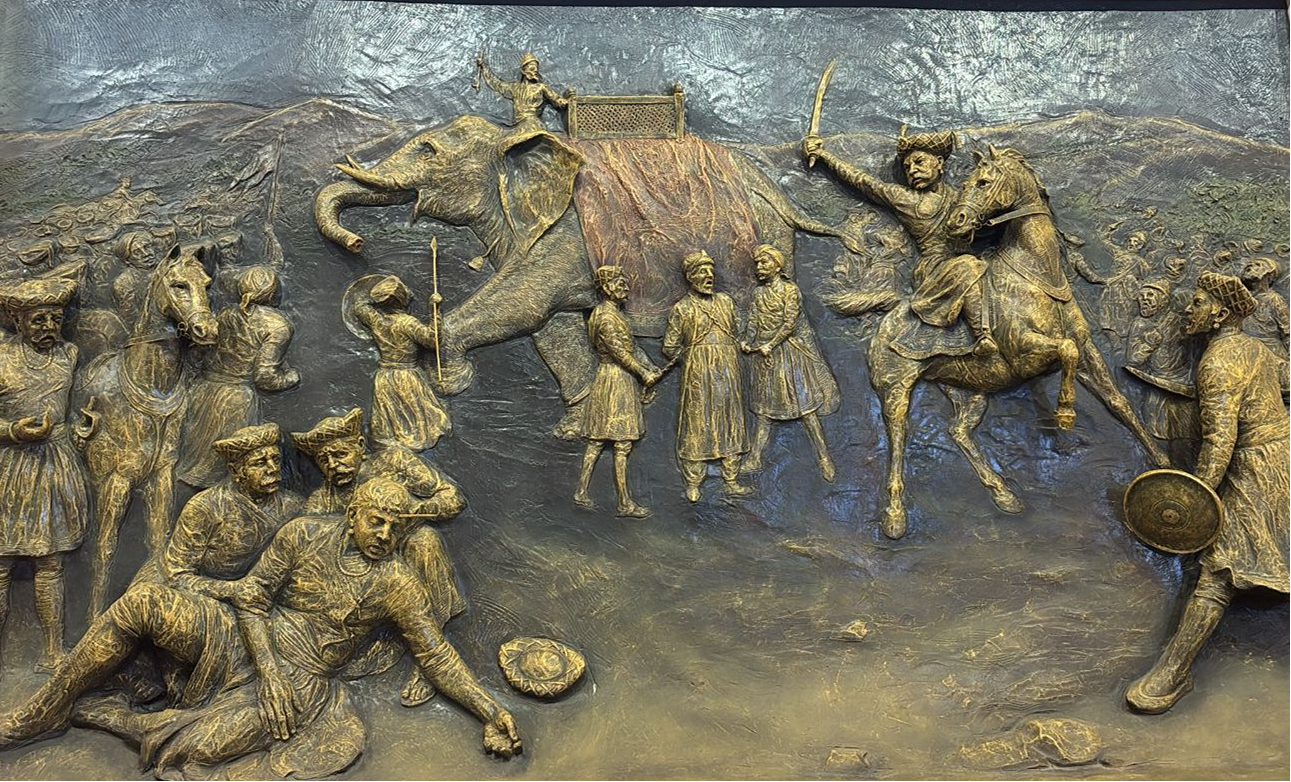
Shivaji Maharaj's Karnataka Expedition

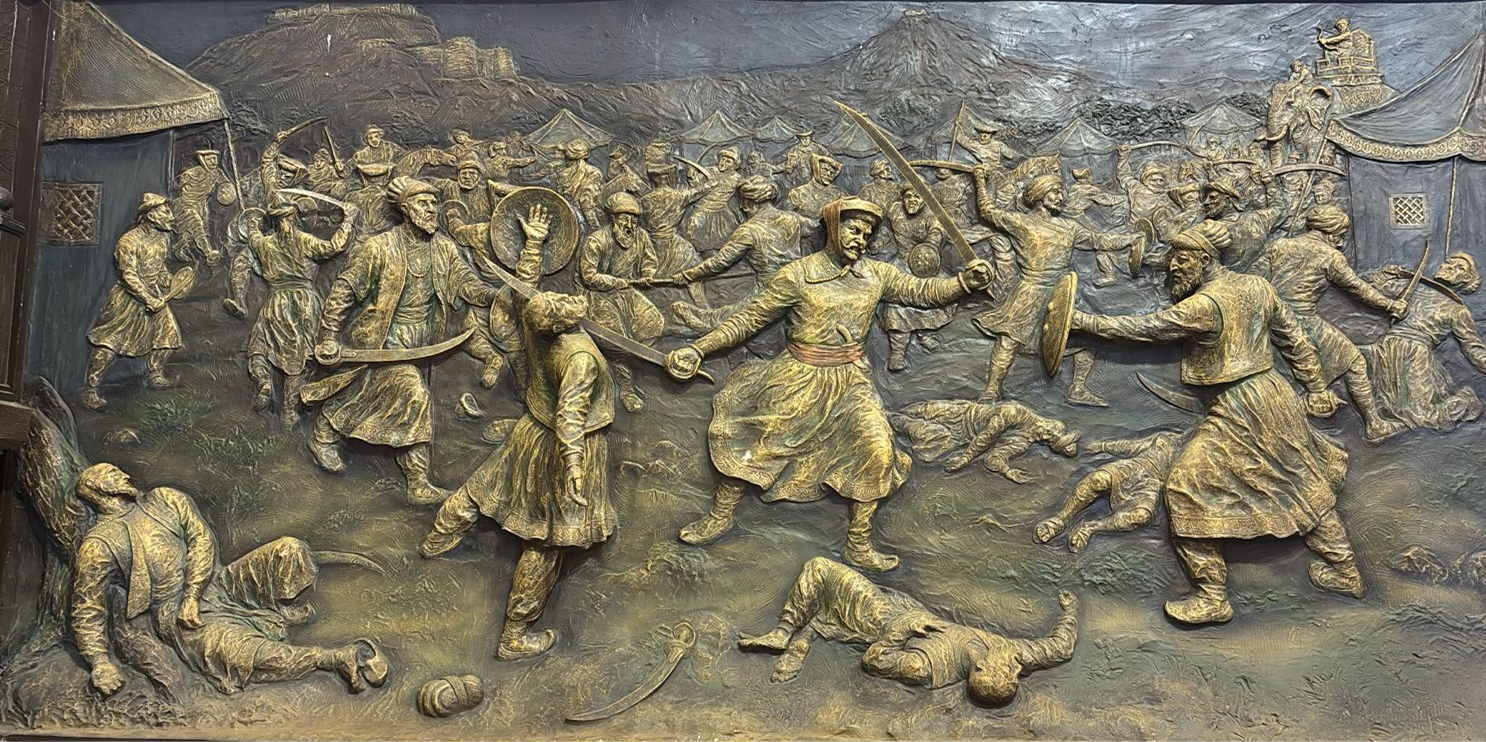
Distressed citizens of Koppal came to Shivaji Maharaj and pleaded to be rescued from the cruelty of the Pathan rulers there. Shivaji Maharaj deputed Sarsenapati Hambirrao Mohite for the task, and Hambirrao marched to Koppal with his army. In the battle, Nagoji Jedhe wounded the Khan's elephant, while Husain Khan Miyana shot an arrow at Nagoji Jedhe. Hambirrao Mohite captured the Khan and, along with him, 2,000 horses, many elephants and a great deal of valuable property, which he presented to Shivaji Maharaj for Swarajya.

Back to top ↑
Mural 18

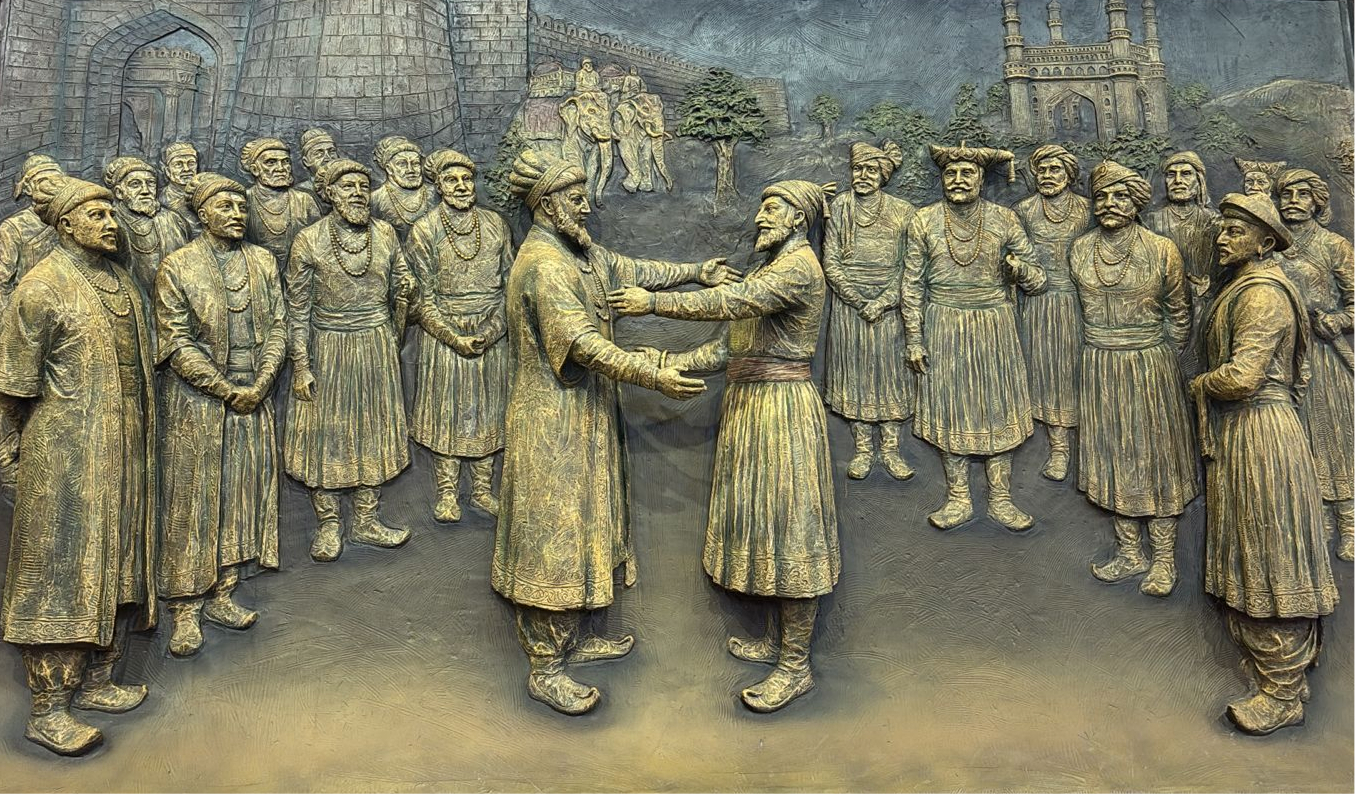
Meeting at Dad Mahal

Shivaji Maharaj and Abul Hasan Tana Shah Qutb Shah met at the Dad Mahal in Golconda Fort. The two embraced, and Qutb Shah, pleased with Shivaji Maharaj, honoured him by seating him beside himself. They held long conversations and exchanged precious gifts. The Qutb Shahi ministers, Akkanna and Madanna, were present on the occasion.

Back to top ↑
Mural 19

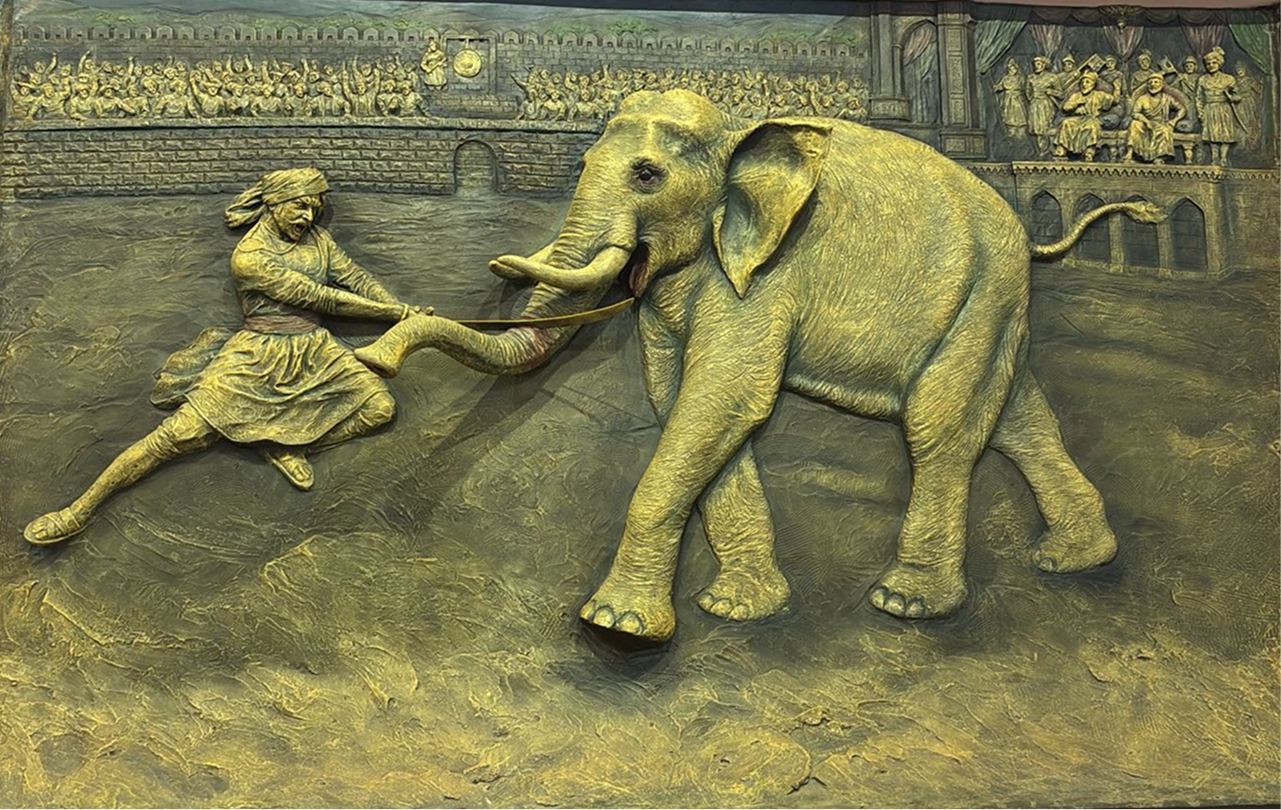
Yesaji's Bravery Against Qutb Shah's Mighty Elephant

On 19 February 1677, Yesaji bravely faced the mighty elephant of Qutb Shah and managed to sever its trunk with his sword — a testament to the courage of the soldiers of Swarajya.

Back to top ↑
Mural 20

Shivaji Maharaj Dines at Madanna's Home

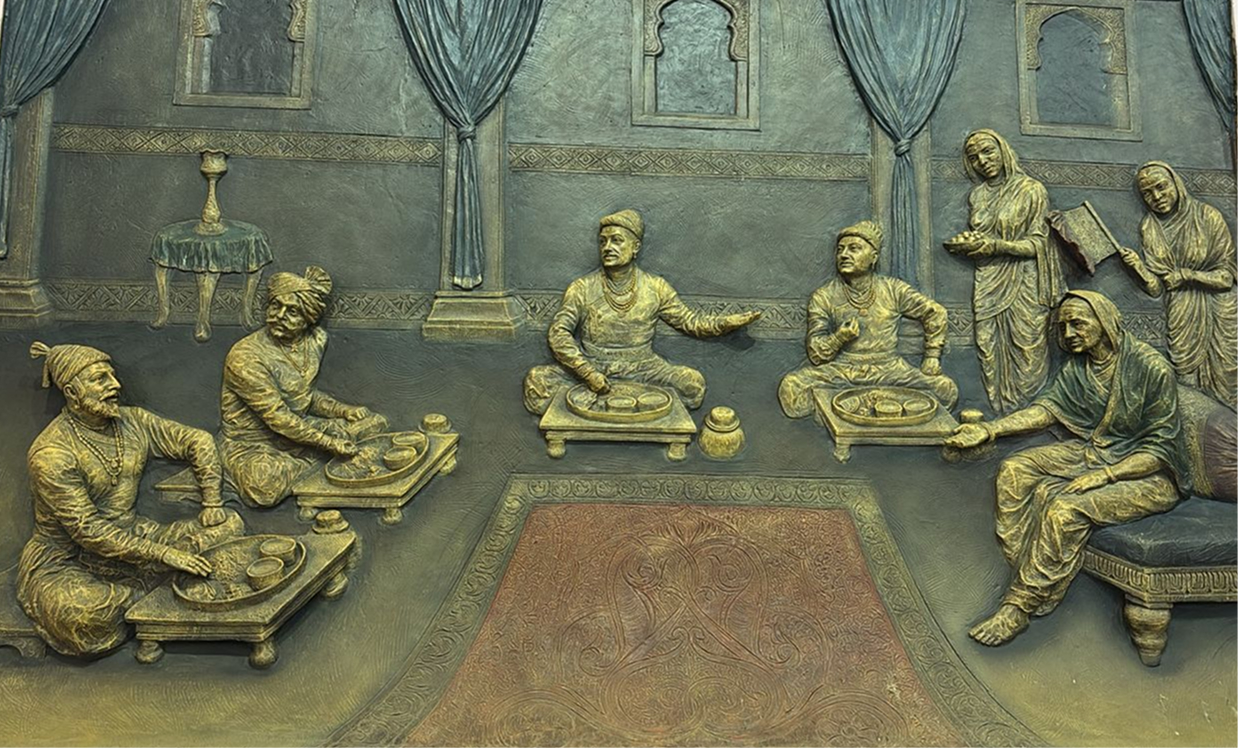
Meetings and invitations continued in Hyderabad for over a month. One day, Pradhan Madanna personally invited Shivaji Maharaj to his home for a meal, and Shivaji Maharaj gladly accepted. Madanna's mother, Bhagamma, cooked the food herself. Bhagamma, Madanna and Akkanna spoke freely with Shivaji Maharaj on many subjects, and Shivaji Maharaj offered elephants, horses, garments and ornaments as gifts.

Back to top ↑
Mural 21

Shivaji Maharaj's Visit to Srisailam

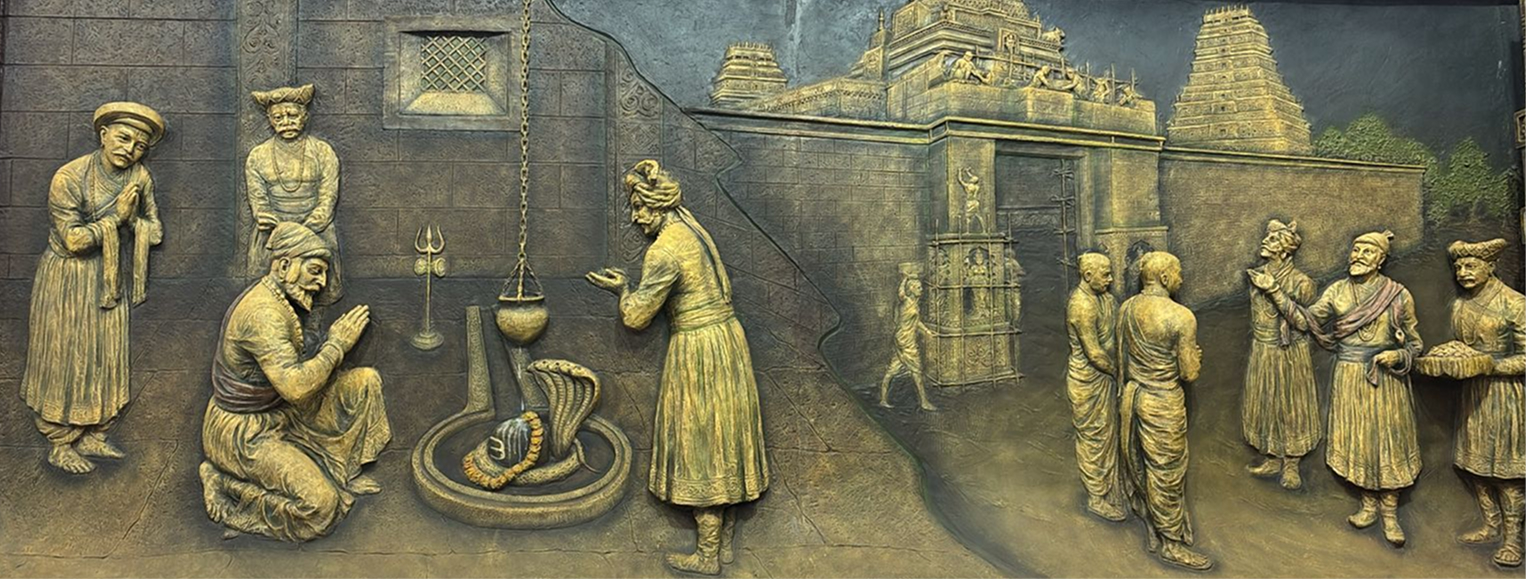
Shivaji Maharaj's visit to Sri Mallikarjuna at Srisailam, one of the twelve Jyotirlingas, is well documented. He arrived at Srisailam on 24 March 1677 to worship Mallikarjuna and stayed at this shrine on the banks of the Krishna river until 1 April 1677.

Back to top ↑
Mural 22

Visit to Tirupati Balaji

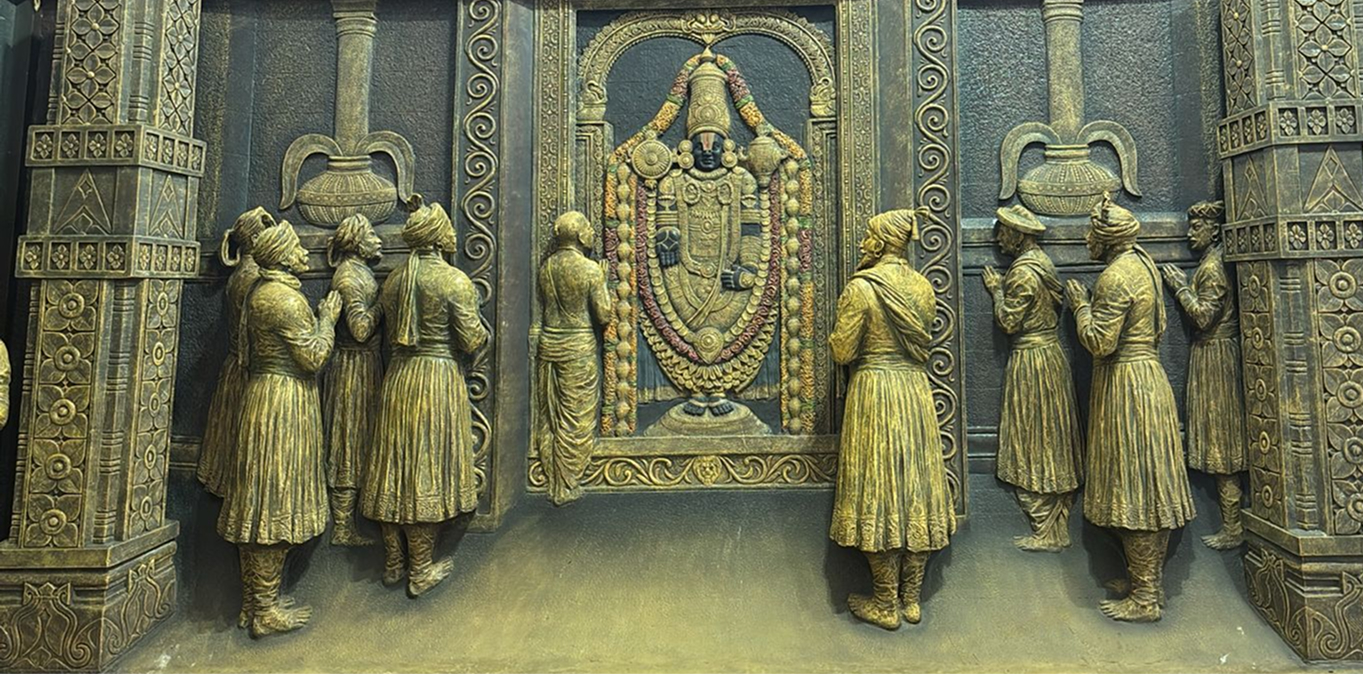
Shivaji Maharaj visited Tirupati Balaji on 4 May 1677. Travelling via Tirupati and Sri Kalahasti to Chennai, and from there via Kanchipuram, he reached the strong fort of Gingee on 9 May 1677.

Back to top ↑
Mural 23

Gingee and the Meeting with Vyankoji Raje

Shivaji Maharaj besieged the great fort of Gingee on 9 May 1677. Gingee is made up of three citadels — Rajagiri, Krishnagiri and Chandragiri — and was commanded by Nasir Muhammad Khan. Shivaji Maharaj took the fort on 13 May 1677 and strengthened it. From 1690 to 1698, Gingee served as the capital of the Maratha kingdom.

Shivaji Maharaj then travelled via the Kollidam (Coleroon) river to Tirumalavadi to meet his half-brother Vyankoji Raje, going forward himself to receive him. The two brothers met after 12 July 1677 at the Pushpabhaneshwar Temple in the village of Tirupnruti, held long discussions and exchanged precious gifts.

Back to top ↑

Join the Shivaji Army or volunteer